


MiniMuse
4.5867.00 Reviews
App Specs
- Version
- 0.9.6
- Updated On
- License
- Free
- Downloads
- 1,000,000+
- Developer
- Studio Sirenia
- Categories
- Role Playing
- Platform
- Android
Screenshots
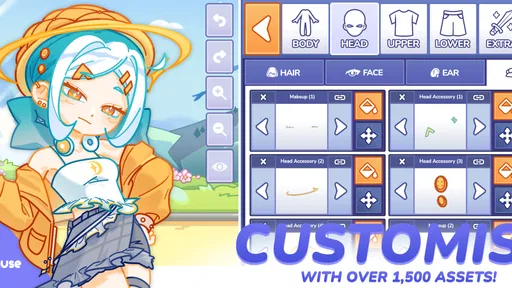



 Analysis by AppCompare
Some role-playing games make their appeal obvious through combat, sprawling maps, or elaborate character systems. MiniMuse takes a quieter route: its central idea is to make the relationship between you and a character feel like the heart of the experience. That makes it an appealing change of pace when I want a story-led game I can approach in short sessions, though it also means players looking for lots of tactical action may find its focus too narrow.
MiniMuse is a free role-playing game from Studio Sirenia, with the store summary framing the experience around a muse and a personal story. In practice, I’d approach it less like a conventional adventure built around constant action and more like a character-focused space for following a narrative. Its 4.5 average from around 10,000 ratings suggests that many players connect with the idea, while the game’s roughly 1 million installs show it has found an audience beyond a small niche.
A character relationship shapes the experience
I find that a character-centered RPG works best when I bring a little attention to it rather than treating it as background noise. In the next section, I’ll look at how that story-first focus can fit into ordinary breaks—and when a different kind of game is the more satisfying choice.
Story first, rather than a broad RPG checklist
The most useful way to think about MiniMuse is as a role-playing game whose identity rests on its central character relationship. That focus can make the experience feel more personal than games that divide attention among long quest chains, equipment menus, and battles. Instead of treating the story as a brief pause between systems, the game’s premise gives the character bond room to carry the appeal.
That focus is also a clear trade-off. In a more traditional RPG, I might spend a session improving a build or working through a combat challenge even if I’m not especially invested in the plot. Here, the reason to return is more closely tied to whether I care about the character and want to see the story develop. If that connection lands for you, the narrower focus is a strength; if not, it may leave less to hold your attention.
I wouldn’t recommend judging it by how much it resembles a large, mechanics-heavy role-playing game. The better question is whether a character-led story suits the way you like to play. Someone who enjoys pausing to consider a narrative and returning to it later may find the premise more inviting than an RPG that expects sustained attention to combat or exploration.
How to make short sessions feel satisfying
A practical way to fit MiniMuse into a busy day is to treat it as a small story break rather than a game that needs a long uninterrupted block. For example, I could open it during a quiet part of a commute or while winding down in the evening, follow the character-focused experience, then stop when I’m ready to do something else. That approach works best when I’m in the mood to pay attention to a narrative, not when I only have a few distracted seconds.
Worth Reading Before You Choose

EA SPORTS FC Mobile 26 Is a Bigger Football Game, but It Takes Time

Flipboard Shows What News Apps Must Do Beyond the Feed

Switching to Android Auto Means Rethinking Your Driving Routine

Google Calendar Makes a Crowded Week Easier to Manage

Ludo King Makes the Most of the Minutes Between Plans

Baby Panda World Brings Quick Play to Modern Phones, but Its Game Library Feels Busy
One useful habit with story-led games is to give myself a simple stopping point: finish the exchange or moment I’m currently following instead of repeatedly opening and closing the game mid-thought. That isn’t a special feature claim about MiniMuse; it’s a way to get more from a relationship-centered game without turning it into a chore. A little uninterrupted attention can make a character’s story easier to follow than scattered, half-focused check-ins.
It is also worth deciding what kind of mood I want before opening it. If I’m looking for a quick burst of challenge, a puzzle or action game is likely a better fit. If I want to settle into a fictional connection and let that be the main reason I’m playing, MiniMuse is much closer to what I’m after. Being clear about that distinction helps avoid expecting a compact story experience to behave like a full-scale adventure.
The everyday situation where it makes sense
Imagine finishing a busy day and wanting something more involving than scrolling, but not another demanding game that asks for constant reactions. MiniMuse suits that gap: I can give the story my attention for a while without needing to plan a long play session around a complicated RPG routine. It can also work for someone who enjoys character-focused fiction but wants the light structure of a game rather than simply reading a novel.
That use case has a limit. If I’m sharing a noisy space, checking my phone between tasks, or feeling too tired to follow a story, a character-led game may not be the easiest choice. It is not automatically a good fit just because a session can be short; the appeal still depends on being willing to engage with the character. For those moments, a game with clear, self-contained rounds may be more satisfying.
Where it differs from familiar role-playing games
Compared with a combat-centered RPG, MiniMuse puts a different kind of investment in the foreground. The usual alternative may offer a steady loop of battles, rewards, and character upgrades, giving players concrete progress even when they are not deeply absorbed in the story. MiniMuse’s draw is more personal: the reason to continue is the character and the narrative experience around them.
That makes it a less obvious choice for players who want freedom to experiment with party setups, optimize statistics, or roam through a large world. Those are valid reasons to choose another role-playing game, not shortcomings every player must overlook. I’d pick a conventional RPG when I want systems to master and a broader sense of adventure; I’d pick MiniMuse when I want the character connection itself to be the main event.
There is a second useful comparison: interactive fiction can provide a more direct, reading-centered experience, while MiniMuse packages its story as a game. If I mainly want prose and don’t care about the role-playing framing, a dedicated reading app or interactive story may suit me better. If I prefer the feeling of entering a game built around a character, MiniMuse’s format is more appealing.
Things to consider before settling in
MiniMuse is free to start, but it includes in-app purchases priced from $6.99 to $13.99 per item. I’d keep that in mind before getting attached to the experience and make a deliberate choice about spending rather than treating purchases as a necessary part of enjoying it. The presence of optional purchases is especially relevant for a story-focused game, where curiosity about what comes next can make it easy to act impulsively.
A sensible approach is to try the free experience first and decide whether the central character and tone work for you before paying for anything. That way, the decision is based on whether you genuinely want more of this particular experience, rather than on the general promise of a role-playing game. If you prefer games with a clearly bounded one-time cost, a paid title without item-based purchases may feel more comfortable.
The game is rated for Everyone, which makes its listed age classification broad, but that alone does not tell me whether the story will suit every player’s tastes. I’d still consider whether the character-centered style is right for the person using it. For younger players, it is sensible to make purchase choices deliberately and to involve a parent or guardian where appropriate.
MiniMuse is currently at version 0.9.6 and requires Android 7.0 or later. That makes device compatibility worth checking before downloading, particularly if you use an older phone or tablet. The game is free, so trying it is a low-cost way to see whether its particular approach works for you, but compatibility and comfort with in-app purchases are still practical parts of the decision.
Who is most likely to enjoy it
I’d point MiniMuse toward players who care about a central character, enjoy a story-led role-playing experience, and prefer to return for personal narrative rather than a constant stream of combat challenges. It may be especially appealing if you want a game that can occupy a quieter part of the day and do not need every session to involve complicated planning or competitive play.
I’d steer away from it if your idea of a satisfying RPG depends on deep tactical battles, extensive exploration, or a large selection of systems to learn. I’d also choose something else when I want a game that works well with almost no attention, or when I’d rather avoid in-app purchases altogether. Those players are not missing the point; they simply have a different idea of what makes role-playing fun.
At its best, MiniMuse’s appeal is its willingness to center the experience on a character bond instead of trying to be every kind of RPG at once. That makes it easier to recommend to someone who wants a personal, story-focused change of pace, but harder to recommend as a universal role-playing game. If that narrower promise sounds like what you want, MiniMuse is worth trying for free; just give its story your attention and decide for yourself whether the connection keeps you coming back.
Pros
- Compact format makes it easy to browse during short breaks.
- A simple interface is approachable for first-time users.
- Useful for exploring creative ideas without a complicated setup.
- Works well for users who prefer focused
- bite-sized content.
- A lightweight concept can suit casual
- everyday use.
Cons
- Its appeal may be limited if you prefer more in-depth content.
- Some features or content may require an internet connection.
- The small-screen layout may feel cramped during longer sessions.
- Available options may not offer much customization.
- The experience may feel repetitive with frequent use.
FAQs for MiniMuse
What is MiniMuse, and what can I use it for?
MiniMuse is the name of an app, but its exact purpose and features may vary depending on the version and developer. Before downloading, check the app’s store listing for a clear description, screenshots, supported features, and recent updates. This helps you confirm that the MiniMuse you found matches what you need, rather than relying on the name alone.
Is MiniMuse free to download and use?
The cost of MiniMuse depends on the version available in your region. An app may be free to install while offering in-app purchases, subscriptions, or paid features. Review the store listing’s pricing information before downloading, and check any subscription terms carefully, including the renewal period and cancellation process, so you understand potential charges in advance.
Is MiniMuse available for Android and iOS?
Availability can differ by platform, country, and device, so look for MiniMuse in the official Google Play Store or Apple App Store. Confirm that the publisher and app details match the version you want, then check the listed operating-system requirements. If you cannot find it in your region’s official store, avoid unofficial download sites, which may provide altered or unsafe files.
What permissions or personal information might MiniMuse require?
The permissions MiniMuse requests depend on what its features do and which version you install. Check the store’s privacy information and review permission prompts on your device, granting access only when it makes sense for a feature you intend to use. You can also consult the developer’s privacy policy to learn what data may be collected, how it is used, and whether it is shared.
How can I tell whether MiniMuse will work on my device, and what should I do if it has problems?
Before installing MiniMuse, compare your device’s operating-system version and available storage with the requirements shown on its official store page. Read recent user reviews for reports about compatibility, crashes, or missing features, keeping in mind that experiences can vary across devices. If you encounter trouble, update the app, restart your device, and contact the developer through the store listing for support.


